The API I spent two weeks perfecting? Deprecated.
The architecture I carefully designed? Replaced.
The framework I mastered? Legacy.
And somehow I’m supposed to find meaning in that.
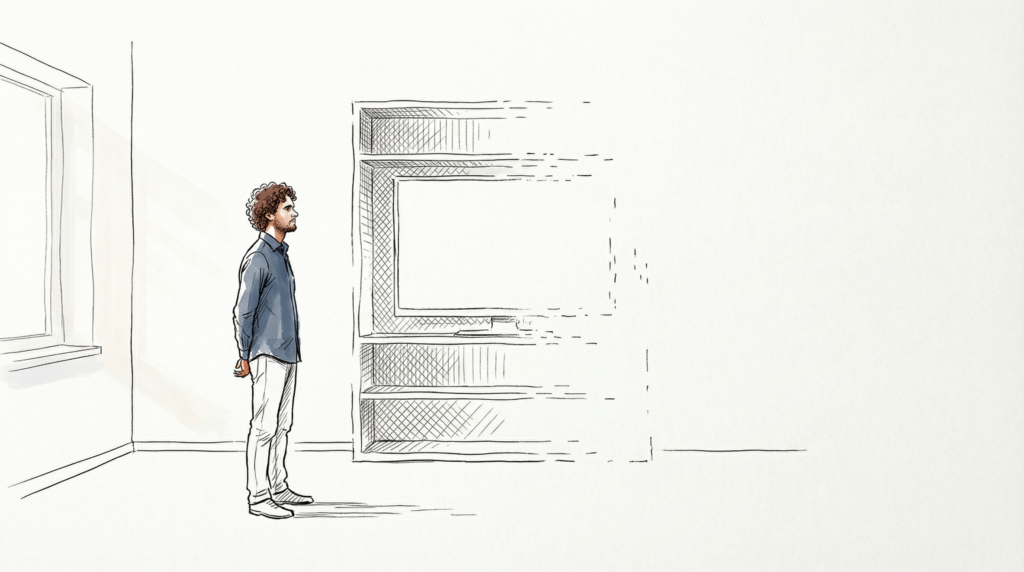
Alan Watts wrote about “the wisdom of insecurity,” and I keep thinking about how perfectly that describes developer life. Here’s what he said: “the past only exists in the present, as a representation we conjure in our minds. Likewise, the future is an illusion, pure imagination. Yet, we create our anxieties and insecurities by clinging to these imagined representations as though they are real.”
For developers specifically: we’re trained to plan ahead, anticipate edge cases, design for future requirements. But all that future-orientation creates suffering when we realize that future never solidifies. It’s just more present moments where our old code is obsolete.
The Brain-Body War
Watts also observed something I’ve watched play out in every dev team I’ve been on: “we have been taught to neglect, despise, and violate our bodies, and put all faith in our brains.”
The brain wants to optimize, debug, solve problems. The brain makes promises: solve this problem, implement this feature, ship this release, and THEN you’ll have produced something meaningful.
Meanwhile the body is saying: “you’ve been sitting for six hours, you haven’t eaten, you’re exhausted.”
We ignore the body. We trust the brain. And the brain keeps lying to us about permanence.
I noticed this pattern recently with hydroponics, failing badly at it, honestly. Plants don’t optimize for future harvest. They just grow. They’re present-oriented. Meanwhile I’m calculating nutrient ratios and growth projections, completely missing the actual plant in front of me.
Same pattern in code. I’m so focused on future architecture that I miss the working system I’ve already built. The present-moment system that works. And then I’m resentful when it gets replaced.
Impermanence as Feature, Not Bug
Here’s what Vedanta helped me see: impermanence isn’t the problem. Clinging to permanence is.
Every system decomposes. Every codebase becomes legacy. Every tech stack becomes outdated. This is not failure, this is how reality works.
The suffering comes from organizing your identity around producing permanent artifacts in a domain defined by impermanence.
I used to measure my value by shipped features. Which meant my value continuously decayed as those features became obsolete. Exhausting feedback loop.
But what if I got that backwards? What if the value isn’t in the artifact but in the awareness I brought to building it? The learning, the problem-solving, the collaboration? Those don’t become obsolete when the code does.
The work itself was worthwhile. The code lasting forever was always a fantasy.
Trusting Ishvara (Even in the Tech Stack)
In Vedanta terms, there’s a principle: do your best, trust Ishvara with the results. Ishvara is this idea of universal intelligence, the intelligence that runs the system, that you can’t control.
Practical translation for code: Write good code. Make thoughtful decisions. Then let it go.
The framework will get replaced. The architecture will evolve. That’s not your failure, that’s the nature of the domain.
This doesn’t mean “don’t care about quality.” It means: care about the work itself, not whether it lasts forever. Care about the decision-making, not the permanence of the output.
Real situation: We rebuilt a major system at work. Three months later, business requirements changed. Half of it needed rework.
Old me would’ve been devastated, wasted effort, failed architecture, I made wrong decisions. Current me: we did the best we could with the information we had. Now we have new information. The awareness we developed from building that system? That’s not obsolete.
The Technical Mirror
Think about memory management in any language. Objects get created and destroyed constantly. The system doesn’t mourn destroyed objects or try to make them permanent.
Code gets written and deleted constantly. Projects get launched and deprecated. The entire industry is built on this impermanence.
The anxiety comes from not accepting it.
We designed our tools around the fact that software is temporary. Garbage collection exists because we accept that objects will be destroyed. Version control exists because we know code will change. Refactoring is only necessary if we accept that yesterday’s perfect design won’t work for today’s requirements.
The system already knows impermanence is a feature. We’re the only ones still fighting it.
The Question That Changes Things
Next time you’re writing code, try this:
Notice when you’re oriented toward “what this will become” versus “what I’m doing right now.”
Not that planning is bad. But notice the difference between thoughtful planning and anxious future-clinging. Between designing for real requirements and designing against hypothetical disasters.
Then ask yourself: If this code became obsolete tomorrow, would this moment of writing it still have been worthwhile?
If the answer is “no,” you might be investing energy in permanence that doesn’t exist. You’re optimizing for a future that can’t satisfy you because futures never arrive, they’re just more present moments.
If the answer is “yes,” you’re onto something. You’ve found meaning in the work itself, not in the output. The awareness you bring to the building, not the artifact that gets built.
That’s the shift that changes everything.
Reply and let me know: Does this land for you? Are you stuck in the future-optimization trap too, or have you found your way to present-moment code work?
The audio narration is produced using ElevenLabs Studio.

Back my efforts by registering through my affiliate link – I earn a commission as an affiliate.
Thanks for reading The Conscious Coder! Subscribe for free to receive new posts and support my work.